


The use of water is increasing due to a combination of population growth, economic development and shifting consumption patterns. “The United Nations World Water Development Report 2021” was recently published: let’s take a look at some interesting data to understand the current state of available water resources and to highlight the need for a better management of these resources.
Freshwater withdrawals in the world
In the last century, global freshwater withdrawals have increased sixfold and for 40 years they have continued to grow at a rate of roughly 1% per year (AQUASTAT, n.d.).
The fresh water consumption continues to grow mainly in the majority of emerging economies as well as in middle- and lower-income countries (Ritchie and Roser, 2018).
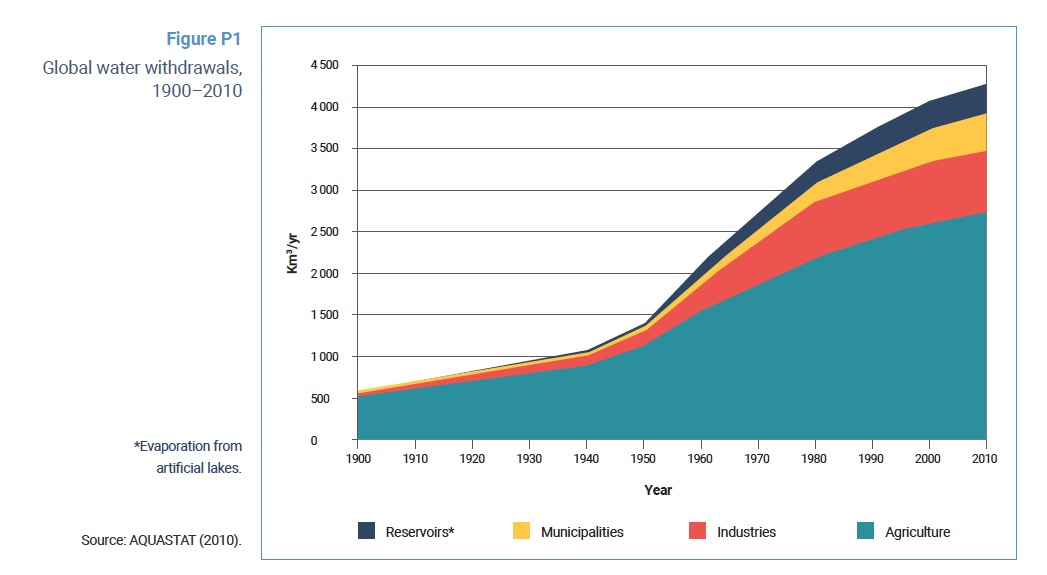
As you can see in the graph (Fig. P1), Agriculture currently accounts for 69% of global water withdrawals, which are mainly used for irrigation but also include water used for livestock and aquaculture. This ratio can reach up to 95% in some developing countries (FAO, 2011a). Industry (including energy and power generation) accounts for 19%, while municipalities are responsible for the remaining 12%.
The problem of an increasing water stress
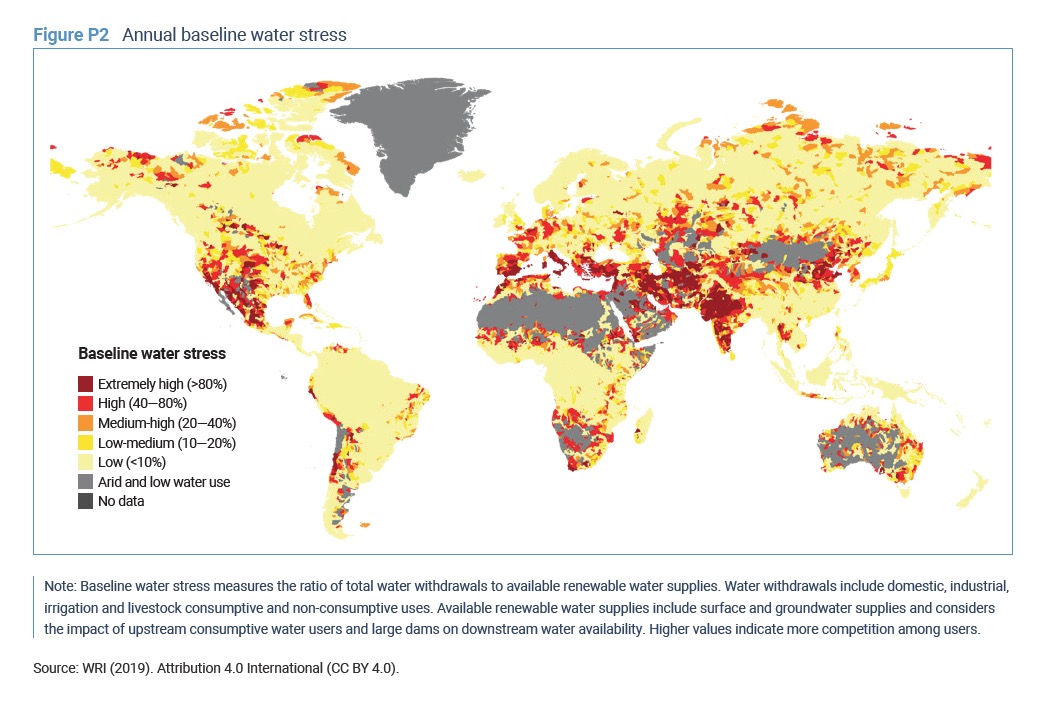
Water stress, essentially measured as water use as a function of available supply, affects many parts of the world (Fig. P2). 30% of the largest groundwater systems are being depleted (Richey et al., 2015). Over two billion people live in countries experiencing water stress (United Nations, 2018). In addition to physical water stress (which is often a seasonal phenomenon) there is a scarcity of economic water for about 1.6 billion people: they lack the necessary infrastructure to access that water (Comprehensive Assessment of Water Management in Agriculture, 2007). There are also several factors that aggravate water stress such as climate change, extreme events such as floods, storms and droughts (which have increased by more than 50% in the past decade), pollution (80% of all industrial wastewater and urban water is released into the environment without any preventive treatment, with a further deterioration of the general water quality and consequent risks to human health, environment and sustainable development).
«Ko au te awa, ko te awa ko au» – I am the river, the river is me»
In many countries subject to water scarcity, policies and regulations are in place that tolerate the waste and excessive use of water: this means that this precious resource is used more intensively and wastefully than in other countries where it is more abundant. There are still too many gaps in the measurement and monitoring of water resources that potentially limit any future action agenda on water assessment.
A proverb of the Whanganui River tribe says «Ko au te awa, ko te awa ko au» – I am the river, the river is me: the fate of humans and water is inextricably linked and an understanding of the overall value of water is necessary to guide political decisions towards a more sustainable management of this resource.